CriticalSpectator’s “Malaypartheid” accusation based on factual half-truths
A Singaporean-based blogger, @CriticalSpectator, recently pulled off a stunt creating headlines by posting on his Facebook page remarks implying certain sentiments among Malaysian Malay Muslims regarding the Palestine–Israel conflict and the war on Iran. The framing demonstrates intellectual dishonesty, or at least intellectual laziness and ignorance – as well as, in his own words, portraying them as “brainwashed and fundamentally bigoted”. It was reported in The Rakyat Post as well as its Facebook page.
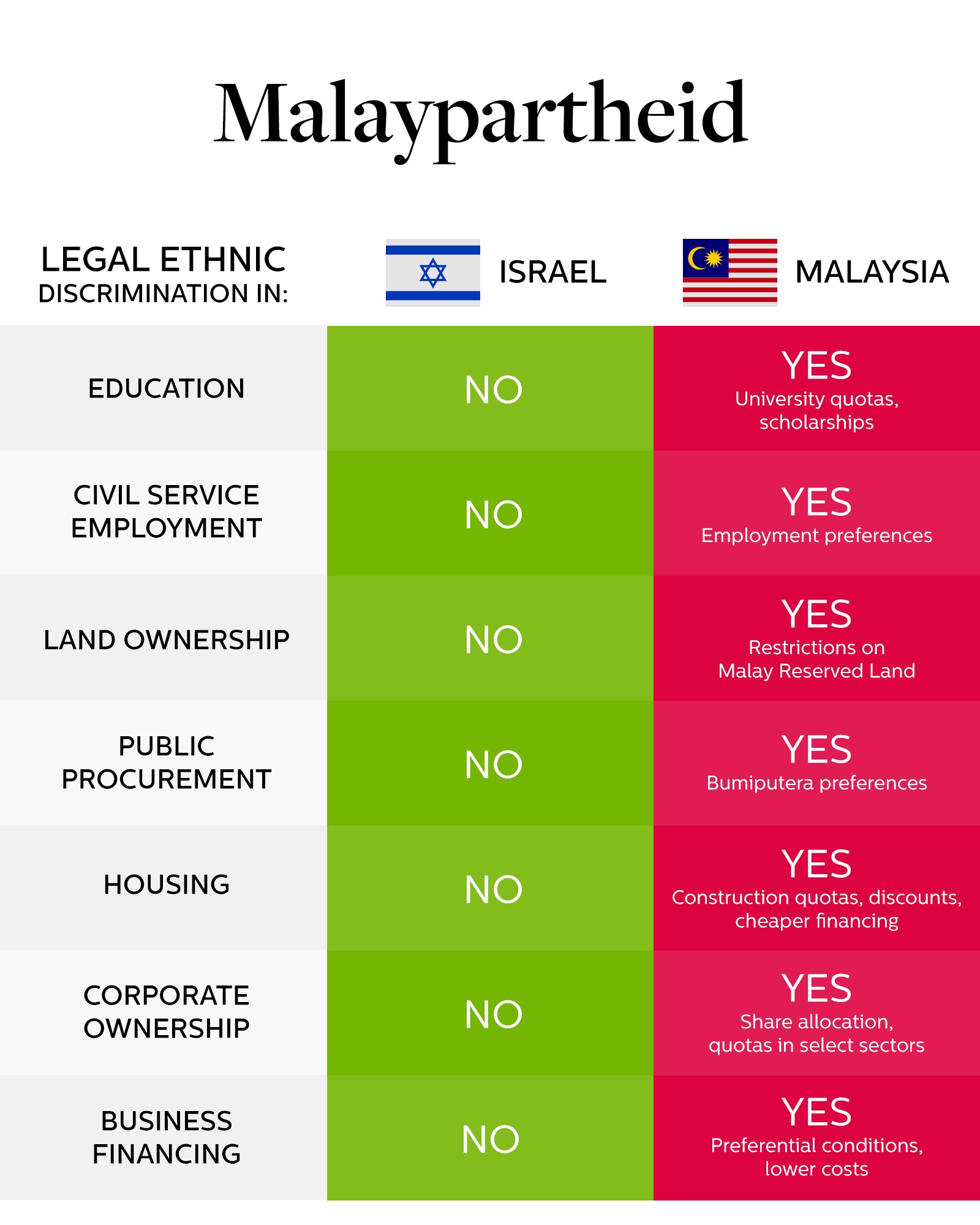
CriticalSpectator implied hypocrisy among Malaysian Malays by comparing Malaysia’s Bumiputera rights with Israel, implying it an apartheid system and calling out what he described as their “imaginary” moral superiority. His first post has since been removed by Facebook. He then reposted a chart comparing legal ethnic discrimination in Israel and Malaysia with the title “Malaypartheid”. Not to worry – I too created my own charts with facts duplicating his style below.

|
| CriticalSpectator’s chart on so-called “Malaypartheid” with facts but misleading half-truths to represent Malaysia's Bumiputera rights as an apartheid. |
The chart is most probably factually correct on paper. However, presenting half-truths can easily manipulate readers and listeners regarding the broader reality. Another example of such a propaganda tactic that I have seen lately, on a different topic, is the claim that slavery predated the Atlantic slave trade and that Britain was the first to abolish slavery – an argument I intend to address in the future.
CriticalSpectator later republished his original post on his blog here: https://critical.sg/malaypartheid-the-controversial-post-republished-here/. Funnily enough, all by the time of my posting, it seems that not just his posts, but also his entire Facebook page can’t be found.
His opening statement reads:
“Between sobbing their eyes out for Palestinian terrorists and the murderous Iranian regime, many Malaysian Muslims like to come here to try to convince all of us of their (completely imaginary) moral superiority.”
Firstly, to say that Israel is killing “Palestinian terrorists“, and to label the anti-genocide or anti-Israel movement as glorifying terrorism, is either to believe that all Palestinians – women and children – are terrorists, or that Israel is not targeting non-combatants, and to deny that a genocide is happening.
Also, how brainwashed can one be to consider Hamas a terrorist organisation, but not consider governments that have been, and are still, terrorising other nations – such as the U.S. and Israeli governments – as terrorist organisations?
Disclaimer: I want to try to be as fair as possible in whatever I represent. While the opening section above consists of opinion, the following two section are grounded primarily in historical evidence, with limited interpretation aimed at providing context absent from CriticalSpectator’s half-truths.
Apartheid vs. so-called “Malaypartheid”
|
|
| Apartheid vs. so-called “Malaypartheid” |
Secondly, if you were to compare Peninsular Malays complaining about the rights of East Malaysian territories and their autonomy while defending and taking offence at non-Malays questioning their Malay rights, and label this as hypocrisy, that’s perfectly fair, since it is a comparison of rights against rights. But when comparing one non-murderous group with a genocidal group – yes – the non-murderous group is morally superior to the genocidal group. When a group is murderous, we need the voice of all groups, despite their imperfections in how they treat others, to speak out against it, so long as they themselves are not murderous nor complicit in murder or genocide. To compare these two and call it hypocrisy is either intellectually dishonest or intellectually lazy and ignorant.
Third: To compare Malaysia’s Bumiputra rights in this way also demonstrates that he lacks an understanding of history. This is where CriticalSpectator demonstrates historical ignorance. CriticalSpectator attempts to equate Malaysian Malays with Israel, since both are the ruling demographics. However, the reality is quite different.
In the geographical region known by various historic names, such as the Holy Land, Palestine, and Israel, the current ruling demographic were European Jewish migrants who had been living in Europe for many generations, absorbing European culture, adopting European surnames, and no longer speaking Hebrew, which had to be reinvented. In contrast, in Tanah Melayu, also known as Malaya, the current ruling demographic were the very locals, predominantly Malays – as well as other Nusantara peoples such as the Bugis and Javanese who adopted Malay culture and identity – who had internationally recognised sovereign local kingdoms in the form of sultanates established centuries before the arrival of British colonialism.
The European Jewish migrants, now known as Israeli settlers, were supported by Britain and the U.S. in creating a government within the already existing British Mandate of Palestine, eventually beating the local Palestinians, who were under British administration, to establishing sovereignty – essentially giving the migrants rights that they previously did not have over the local Palestinians. In contrast, in Malaya, the British came to take away sovereignty from established local sultanate governments, referred to by the British as the Malay States. These sultanates fell under British colonial rule, and the sultans were stripped of power over their own dominions, except for cultural and religious matters. The British controlled all other matters, including immigration, and facilitated large-scale migration of Chinese and Indian migrant for labour recruitment, over which the sultans had no say.
While in the Holy Land, there was harmony among the Palestinian Muslim majority, Palestinian Christians, and Palestinian Jews prior to the arrival of the European Jews, later known as Israeli settlers, who are the very culprits behind creating violent racial chaos that has heightened over the years; in Malaya, the culprits were the British, who ruled over the Malays and intentionally created a plural society with racial tensions, eventually leaving the problems in the hands of the Malays to establish harmony – for which, as evidenced by Malaysia today, they succeeded. Malaysia ranked 13th in the 2025 Global Peace Index, 12th in 2024, and within the top 20 out of 163 countries every year since 2019.
While in Israel and Palestine, the Israeli settlers violently took away rights from the local Palestinians and continue to oppress them to this day; in British Malaya, through peaceful diplomatic negotiations with the British, and with the cooperation of representatives of Chinese and Indian migrants, the Malays won back their rights to their lands, achieving Merdeka – independence – from Britain, and shared – not took away – their rights with the Chinese and Indian migrants, who became citizens.
British-ruled Malaya killed two birds with one stone: large-scale migration of foreign labour for Resource Extraction and Divide and Rule
In British Malaya, Indian migrants were concentrated to to rubber plantations, Chinese migrants to tin mining, which grew into townships hence urban development, while local Malays remained in rural areas for paddy cultivation, but with limited political power. The British also allowed the establishment of vernacular schools – Malay schools for Malays, Chinese schools for Chinese communities, Indian schools for Indians, and premier schools for the elites – to ensure segregation through education. The British killed two birds with one stone with this, that is, to reap the land of its resources while playing ‘divide and rule’ among the races. If you cannot divide the locals, bring in foreigners to create and maintain division.
Prior to British colonial rule, Chinese who had settled in various kingdoms in Southeast Asia often assimilated with the locals, adopting local cultures and languages. This was because, despite the warring and imperial nature of the Chinese Empire, its primary means of accessing resources from smaller distant kingdoms was through building trade relations, which often led to the formation of assimilated settlements, rather than through conquest, as was characteristic of European imperial expansion. The British, by contrast, came to dominate, extract resources, and create racial tensions.
As Merdeka approached, honouring the promise the British made to return political power to the Malays, the plural society of British Malaya, divided by race as created and intended by the British, was left in the hands of Malay political leaders to deal with.
Yes, the Malays did object to and retaliate against the establishment of the Malayan Union by the British, which initially attempted to implement jus soli with equal rights for all. However, this retaliation was understandable. Because the races had intentionally remained segregated, i.e. they did not yet identified as one, with Malays no longer a majority in their own lands at just below 50%, while the Chinese were above 30% and Indians above 10%, unity and integration had not yet organically developed.
Not only were the Chinese culturally inclined towards financial and economic strength, entrepreneurship, and were, of course, hardworking, they were also given an advantage by the British in urban and economic development through recruitment into tin mining, where mining settlements developed into towns. These towns become Kuala Lumpur, Ipoh and Taiping. British colonial Malaya provided reserved lands for the Malays in order to preserve them as a rural peasantry and traditional agriculturalists, supposedly to protect Malay society from economic disruption and to maintain social stability. However, this restricted the Malays from integrating into the capitalist economy and limited commercial development. This economic structure developed into ethnic economic divisions in which the Chinese held the upper hand in the emerging modern economy.
For a people who wanted nothing more than to regain the right to govern their own lands from their colonisers, in an ethnically divided society created by those same colonisers, the concerns of the Malays regarding Chinese economic dominance were legitimate. No group ever wishes to be overpowered by another group, let alone by a foreign group. No group ever wishes to endure the rule of a foreign power, only to be overpowered by another foreign group immediately after gaining independence from the first.
In summary, the price the Malays paid for having the sultans’ power over their own dominions stripped away, and for the extraction of resources from their lands by the British for their own benefit, was to find themselves on the shorter end of the stick in the emerging modern economic world opposite another foreign group.
This is one of the key reasons why Sabah and Sarawak specifically negotiated for, and were granted, autonomy over immigration upon the formation of Malaysia. There would be unrest if the more developed Malayans, regardless of race, were to easily outcompete the local Sabahans and Sarawakians in the industrial sectors. From the perspective of the Malays in British Malaya, the British had already allowed their Malay neighbours in Singapore to become a minority in their own lands. Not to mention Palestine and the Americas.
This retaliation against the Malayan Union led to the establishment of Malay, Chinese, and Indian political parties working together to achieve independence. The climate was such that, although many of the migrants had attachments to the local lands, having been in Malaya for two to four generations, some Chinese groups were still loyal to China. This proved true, as immediately after the disestablishment of the Union came the first Communist insurgency. The communists being predominantly Chinese. While the Chinese who were loyal to the land formed the MCA (Malayan Chinese Association), accepted the limited rights, and were grateful for them, the MCP (Malayan Communist Party), who were loyal to China, were ungrateful and demanded full rights – the irony. This gave further reason for the Malays to be extra cautious about how many rights to grant to the migrants.
Eventually, the Malay political leaders gave rights – and not removed rights – to these former foreigners which they had not previously possessed. I say “foreigners” because that was their status in the Malay States under British colonial rule, just as today’s expatriates and migrant workers are foreigners to us. The Chinese were considered subjects of China, and Indians were subjects of British India. India, too, was under oppressive British rule. Only the Straits Settlements implemented the jus soli (citizenship by place of birth) system, as it was under direct rule of the British Crown Colony. The Malay States, under the control of the British Residents, implemented jus sanguinis (citizenship by descent).
Jus Soli and Jus Sanguinis – how could giving benefits to locally-born foreigners be wrong?
Disclaimer: The previous section is the last part of the historical section. So, in this section, I am not claiming facts, but rather logical reasoning.
Here is where CriticalSpectator demonstrates intellectual laziness. While some countries do implement jus soli, most modern nation-states implement jus sanguinis. If you were to argue that jus sanguinis is morally wrong, then you are on a completely different moral playing field and would need a separate forum to make the case. But if you are like the rest of human society, including the Singaporean and Malaysian governments, which implement jus sanguinis, then jus sanguinis is not morally wrong. Instead, implementing jus soli is simply a matter of extra generosity. The same logic applies to whether a government provides any extra benefits to people born in the country whose parents are not citizens, compared with foreigners not born in the country.
Assuming we are on the same page regarding the above, what logical reasoning could one invoke to first agree that it is not morally wrong to withhold extra benefits from people born in the country without citizen parents, compared with foreigners not born in the country, but then conclude that it is morally wrong to provide such extra benefits? It is safe to assume that these benefits cannot be equal to those given to citizens. What logical reasoning could one invoke to argue that it is not morally wrong to provide said benefits, but becomes wrong the moment the benefits provided are not equal to those of citizens?
That is what occurred in Malaya. Considering that the Chinese and Indian migrants had been in Malaya for between two and four generations, it was not an ordinary circumstance, and rights and benefits to them could be argued as necessary. Upon a series of negotiations with the Chinese and Indian representatives, the Malay political leaders decided that the soon-to-be sovereign government would give – rather than remove – benefits and rights to the Chinese and Indian migrants, but, as expected, not equal to the Malays. The rights to vernacular schools were also retained. Remember that this was right after the Malays had been exploited by the British, and part of the British strategy included bringing in the Chinese and Indians. Also, the Orang Asli, the inhabitants of the land before the Malays, never needed to fight for their rights. It is assumed that they are constitutionally Bumiputera.
In addition to benefits and rights, considering that the migrants came to Malaya for a better life, they were also labelled as citizens so that they would not end up stateless in a changing world. What logical reasoning could one invoke to conclude that it was not morally wrong to provide some benefits, though not equal to those of citizens, but that it becomes morally wrong when citizenship is added to the benefits?
The closest argument for this would be false labelling: that is, claiming to give a group citizenship in words or in writing, but in practice it is not implemented. This is wrong because of the deception. This is what Sabahan and Sarawakian leaders are arguing against Malaya – that what was promised in MA63 was not only fully realised but also, over the years, diluted. In the case of non-Bumiputera status in Malaya, and hence Malaysia, there is no deception. Despite Bumiputeras and non-Bumiputeras being designated as citizens, the difference in benefits and rights is stated clearly in the Federal Constitution.
Closing: Integration or Assimilation
Disclaimer: This final section, though presenting some fact, presents opinions and perspective as opposed to historical facts to conclude this write-up. Opinions can be and is often expected to eventually be found as wrong or outdated.
One may ask, after many years, why Malaysia has not progressed to racial equality? My purpose here is not to answer this question, nor to justify why Bumiputera rights should still be implemented, but to dismantle the fallacies and dishonesty of CriticalSpectator’s accusations. If I were to give an opinion on this matter, I would start by saying that an ideal Malaysia would be one where the country could sustain harmony without segregated rights, while maintaining rich cultural differences – a plural society. However, we need to consider human nature to avoid national instability.
No ethnic group willingly accepts being dominated by another unassimilated ethnic group in their own lands, especially by former migrants originating from foreign lands. Malaysia is in a very unique situation where there are ethnically based rights, as well as ethno-linguistically based vernacular schools that coexist nationwide rather than territorially divided, while also allowing for multiple ethnic political identities.
Malaysia’s strategy towards harmony in a multicultural society is integration, not assimilation, which most countries lean towards. Immediate assimilation would mean abolishing segregated education, which would essentially take away their right to vernacular schools and other ethnic rights in exchange for equal rights. Is that something the Chinese and Indian communities would be willing to trade off for equal rights? Does that mean Sabah and Sarawak have to follow suit?
While some Malaysian Chinese in CriticalSpectator’s comment section applaud him while claiming oppression in Malaysia due to unequal citizenship rights, Indonesian Chinese had to give up aspects of their identity: Chinese characters were banned in the media, and they were pressured to change their Chinese names to Indonesian-sounding names. They were restricted from publicly expressing Chinese culture and religion, and were effectively only allowed to speak Chinese in private. There were also restrictions on acquiring land for the construction of Chinese temples, and the closure of Chinese-language schools. All these took effect under Suharto’s New Order from 1966 until his resignation in 1998, all as the price of equal citizenship.
Malaysian Chinese, by contrast, are free to express and celebrate their culture and heritage, with over 90% attending Chinese vernacular schools, sometimes to the point of surprising unfamiliarity with local Malay culture. I once had a neighbour who could speak neither Malay nor English. It is not uncommon to find Malaysian Chinese who do not know what “bin” and “binti” indicate in Malay names. With such nationwide freedom of cultural expression, Malaysia is often considered the country that produces the highest number of original Chinese New Year (CNY) songs annually (yes!; outcmpeting Chinese and Chinese-majority countries), as well as Chinese New Year-related innovations such as Yee Sang, which is widely popular nationwide, and the high-pole lion dance, which has gained international recognition and adoption. Taken together, these conditions – and even the freedom to remain unfamiliar with local Malay culture – do not strongly reflect the condition of an oppressed group.
So long as Malaysia remains unassimilated as it is, with the Chinese being more economically dominant and the Malays remaining the majority, the Malays would not allow the abolishment of Bumiputera rights. It will take generations and national maturity to achieve equal rights whilst maintaining harmony and satisfying all demographics. Perhaps I will elaborate on this in another write-up, including the possible inconsistency of the Bumiputera status in peninsular Malaysia, how Bumiputera status in the Borneon territories differ from that of in the peninsular, comparison with how other countries handle multi-ethnic societies, and countries ranked higher than Malaysia in the Global Peace Index, as well as discussing racial and religious tolerance practiced in Malaysia, and how Malaya’s first encounter of invasion by Europeans possibly shaped the Malay psyche and their approach towards the British.
Comments
Post a Comment